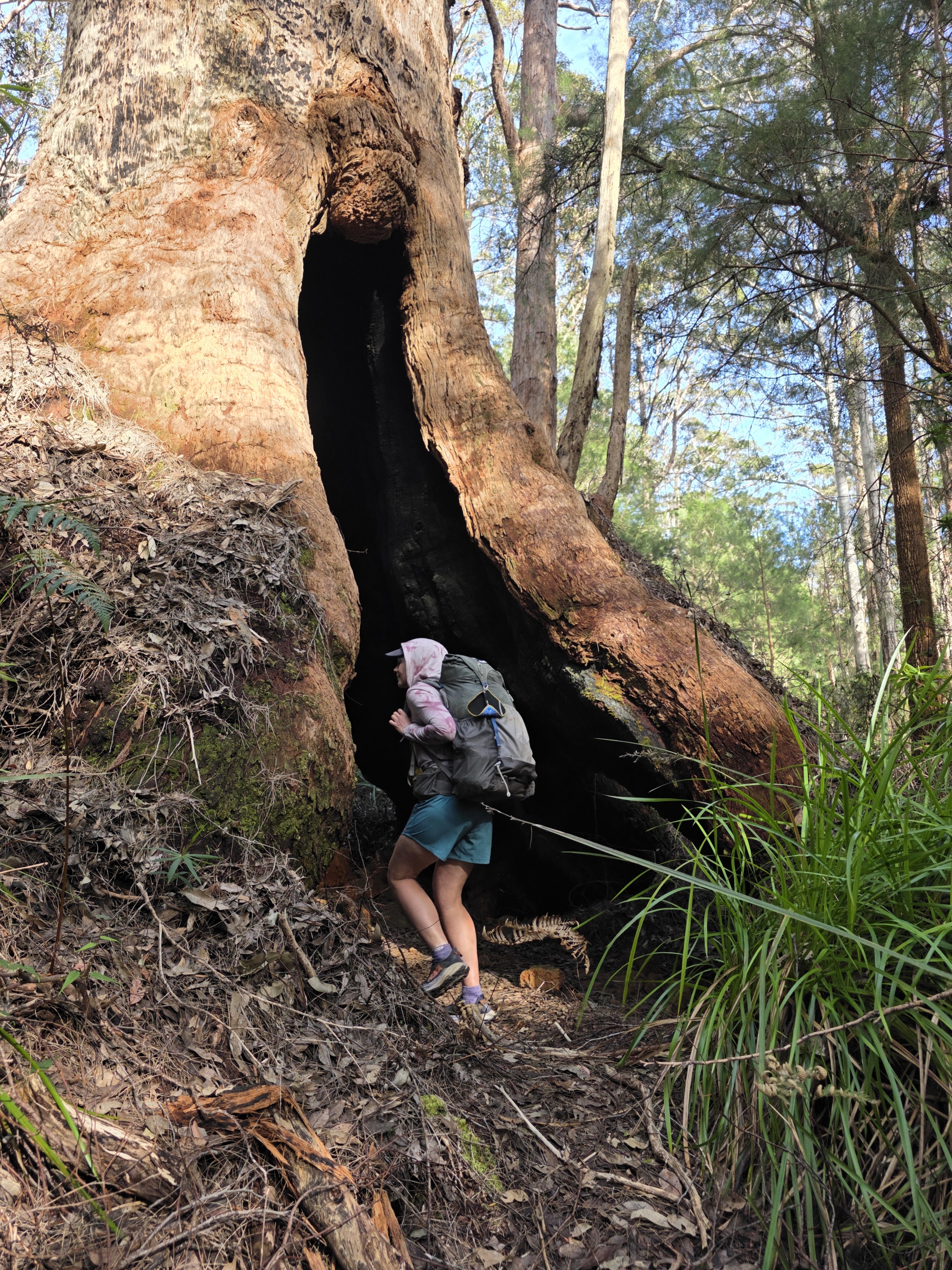
In spring 2025 I set out to hike the Bibbulmun Track end to end, Kalamunda to Albany. It took me 48 days and it rained on 26 of them. So would I hike it again? Probably not. Am I glad I did? Absolutely. Here’s why.

Quick facts
- Started: 17 August 2025
- Direction: Southbound, Kalamunda to Albany
- Time taken: 48 days
- Wet days: 26
- Nights in shelters: all but one
- Season: late winter into spring, in a year that set a 30-year spring rainfall record
Why I chose the Bibbulmun Track
Hiking a long trail in my own backyard is what first drew me to the Bibbulmun Track, along with the chance to experience Australian thru-hiking culture. The more I read about the track, the more the wildflowers and the Western Australian bush pulled me in: towering marri and karri, and awe-inspiring tingle trees with their colossal buttresses.
Another big drawcard for the Bib was its simplicity. It’s a well maintained, well marked trail with a reliable water source and a shelter at the end of each day. Whilst care needs to be taken on any hike, the Bib is easy to plan for logistically. Every 3 to 9 days the trail delivers you into a town where a shower and a supermarket resupply await. The elevation is gentle and the weather is mild (usually!). What a way to spend 6+ weeks in the Australian bush!

What I expected
In all honesty, I didn’t want to go too deep into researching what I would see along the track. I wanted to leave space for the surprise of the unknown, and I didn’t want to know exactly what a particular forest or stretch of coastline looked like before I got there. Personally, I feel that breeds disappointment. Most things we see online these days are overly glossed and unrealistic, and when the real life version doesn’t look like the online version, it can be a let-down.
My only real concern when deciding whether to hike the trail was whether I would get bored of the scenery. I expected few vistas and somewhat of a “green tunnel”, but the wildflowers got me over the line on that point.
The weather: hiking the Bibbulmun in a record wet spring
I started my hike on 17 August 2025, just before the start of spring. It was well timed seasonally, but as annual weather patterns go, 2025 ended up setting a 30-year spring rainfall record. On top of the rain, it was unseasonably cold. The morning I hiked into Dwellingup it was -3°C and hailing, with over 30mm of rain.
I had expected on and off drizzle. I knew WA gets most of its annual rainfall in winter and spring, but I didn’t expect constant heavy rain. Thankfully my gear never wet out, and thanks to the Bib Track’s brilliant shelter system I always had somewhere to dry things at the end of the day. But the constant dampness wore on me. Out of the 48 days it took me to hike the Bib, 26 were wet.
The other thing I hadn’t mentally prepared for was the poor drainage of WA soil. When it rained more than a few millimetres the trail would turn into a river and I’d end up with wet feet. Do with that information what you will.
I also wasn’t prepared for the nights to feel as cold as they did. The first few days were warm and dry, but once the weather turned the temperatures dropped, and I had consistently cold nights until the last couple of weeks on the coast. Despite coming from the Blue Mountains, I was shocked at how cold it was and ended up buying gloves and an extra pair of bed socks so I could get a good night’s sleep. This was very frustrating, because in the few months before setting out I had started experiencing night sweats and hot flushes (hello perimenopause!). Unfortunately they did absolutely nothing to keep me warm at night on the Bib.
Although hiking in the rain made me sad and got me down, especially through long stretches of enclosed forest, it meant full water tanks at every campsite and a spectacular show of wildflowers. All in all, I’d say the rain was worth persisting through.

Shelters and the people you’ll meet
The shelters and the people were a pleasant surprise. When planning at home I didn’t expect the shelters to be as clean and well set up as they were. I chose to sleep in them every night except one (I had to justify carrying a tent all that way).
I can be socially anxious and it can take me a while to warm up to new people, but I went into the trail knowing I would be sharing shelter space with others and chose to lean into the experience. I met some wonderful people on trail, some who irritated me, and some who challenged my ideas about stereotypes and social norms.
In particular, I had heard negative accounts of homeless people living along the trail and was worried about this. But on the one occasion I shared a shelter with a homeless man, I put some effort into making conversation and he opened up. I found him to be a lovely, generous human, and the experience taught me to check myself.


Wildlife: emus, roos and whales
The wildlife! I had completely forgotten about emus and was surprised the first time I saw one. For WA locals it’s like spotting a wombat: a pleasant experience but not unusual. I ended up in hysterics the few times I saw them. They’re a very large, awkward bird and comical to watch crashing through the bushes. I saw too many kangaroos and wallabies to count. Being the first one out on the track early in the morning, watching the roos graze in golden light was magical.
The whales were another pleasant surprise. When planning my hike I was so focused on the wildflowers that I completely forgot about the springtime whale migration! Once I hit the coast and a fellow end-to-ender showed me what to look for (thanks Hayley!), I spent my days and early evenings watching the whales and their new calves frolic their way down the coast line. It was the first time I fully understood the expression “a whale of a time”. It was magical watching them and imagining their huge whale highway under the ocean.


Highlights: wildflowers and tingle trees
The wildflowers were incredible. I chose to hike the track in spring in the hope of seeing them, and whilst I was slightly early in some sections, for the most part I was blown away. The orchids in particular had me testing the limits of my phone’s storage.
The other highlight for me was the tingle trees. They are incredible, and being alone in the bush in their presence was a special moment. I never thought a tree could make me cry, but the tingle trees moved me to tears.

Would I hike the Bibbulmun Track again?
I’m very glad I hiked the Bibbulmun Track and had the opportunity to see a huge chunk of South West WA in such a unique way. There is something special about moving through a place on foot. You feel it in a way you simply can’t otherwise.
Whilst I loved my time on the track, the rhythm of hiking a long trail and the narrow focus and simplicity it brings, I don’t think I would choose to hike the Bib a second time. Mostly because it felt a little monotonous in the middle. In the wet, cold weather it felt like the forest was closing in on me, and at times I “just” wanted to get to town, or “just” wanted to get to the coast for a change of scenery. That said, I think it would have been a very different experience had I not hit the trail in a season that broke rainfall and low temperature records.
I met many WA locals who had hiked the trail multiple times, some thru-hiking it 3 to 5 times. I lost count of how many there were. At first I found it odd. I couldn’t understand why you wouldn’t want to experience something new, a different trail in a different part of the country. After a while I came to realise that the biggest driver behind their repeat hikes was comfort. The Bib is what they know. Many of them were introduced to the outdoors through the Bib, so it feels safe and familiar. And as many said, it’s in their backyard, so why not?
Like they say, sometimes the trail gives you what you need, not necessarily what you want. I believe in this, and I’m thankful for the growth that came from the experiences that challenged me mentally. I wouldn’t wish for an experience other than the one I had.

Is the Bibbulmun Track right for you?
Ask yourself what you’re looking for on this hike. Know that it won’t be one of solitude: for the most part you’ll be sharing huts with others. Understand that the terrain won’t give you grand vistas: you’ll spend most of your time amongst the trees. Pick the season that works for you based on the experience you’re after.
But like my approach to most things, I’d say if you’re on the fence, give it a crack. If you aren’t enjoying it, you can always go home. Life is for living.

FAQ
For me, yes. Even in a record wet spring, the wildflowers, the tingle trees and the whales on the coast made it worthwhile. If you want solitude or big views it may not suit you, but if you love being amongst the trees it’s a special way to see South West WA.
It took me 48 days end to end, from Kalamunda to Albany. Most people take somewhere between six and eight weeks.
I hiked in spring, starting in mid August, for the wildflowers and I’d do the same again. Just be ready for rain, wet feet and cold nights, especially in the forest sections.
I slept in the shelters every night except one. They’re clean and well set up, so most nights you won’t need a tent, but it is best practice to carry one in the event the shelters are full or you can’t reach one during an emergency.
Not usually. For most of the track you’ll be sharing shelters with other hikers, so don’t expect solitude. For me, the people I met along the way turned out to be one of the highlights.
I think so. It’s well marked and well maintained, with water and a shelter at the end of each day, a town every 3 to 9 days, and gentle elevation. That makes it about as easy as a long trail can be to plan.
Leave a Reply